 |
  
 |
| |
|
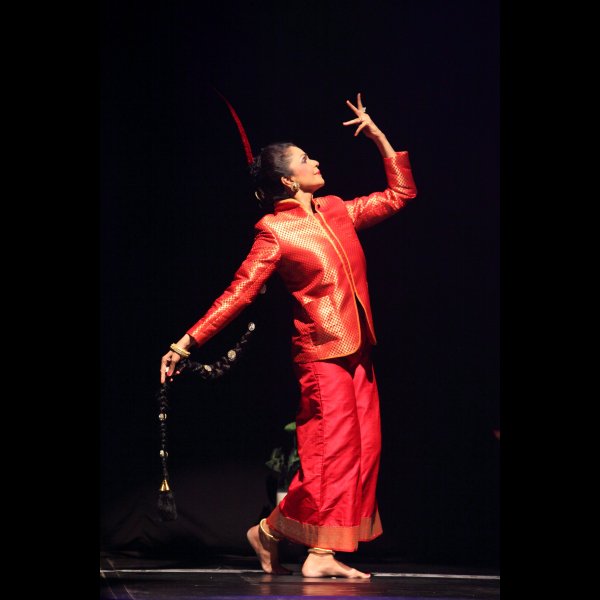 |
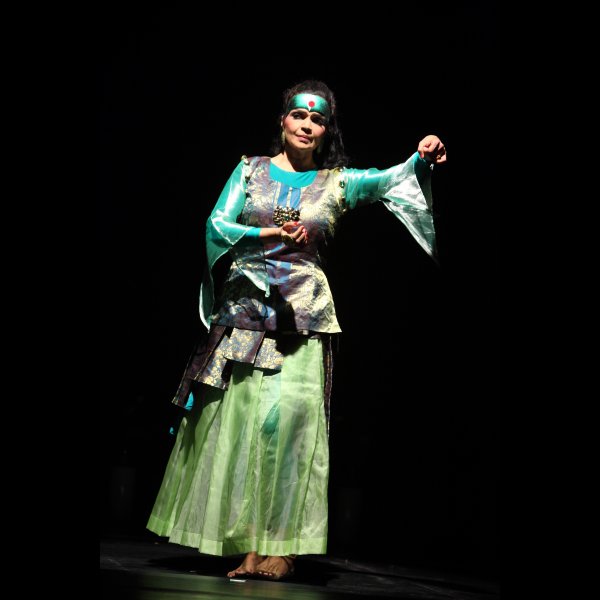 |
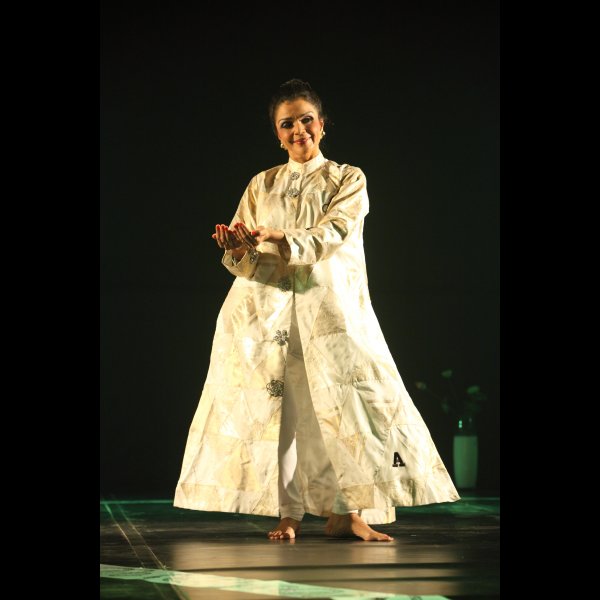 |
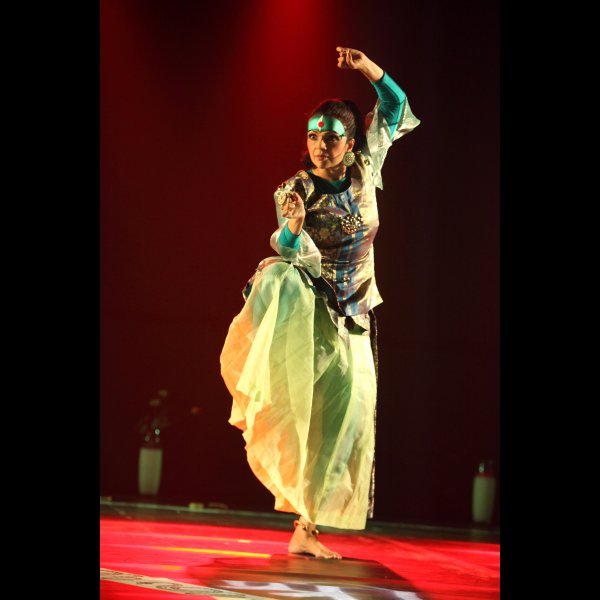 |
 |
Home
| Credits | Synopsis | Calendar of
Performances | Critics Speak | Response | Photo Gallery a dance theatre solo by Anita Ratnam 'I am not a peaceful, calm person' - Nadine Kreisberger Posted online: THIRD EYE STORIES, indianexpress.com, Sunday , Jan 03, 2010 For this kind of conversation, I like meandering and exploring as I feel, let thoughts and feelings unfold, like a river of consciousness. Let me start by saying that I like the metaphor or men and women as trees. The ashoka grows quickly, straightens up, like a man, not worrying about establishing roots or creating a shade; whereas the banyan tree grows wide, with many roots, creating so much shade, but also held up as something the woman should be -- multi-faceted, multi-tasking. I believe we are at a time when women need to be a little bit less of a banyan tree and more of an ashoka. Indian women are far more dynamic than Indian men, really. For centuries, they were actually kept from realizing their potential. Today, some women have the courage to break certain conventions to become more of themselves, more of a whole. For instance, they may leave the Lakshman Rekha of marriage. Instead of appearing to have everything but actually being utterly unhappy, they dare leave and be alone, preferring to become a more realized human being, parent, professional, woman -- but not a spouse. And this, really, was my choice. Today I can safely say that I should not have been married. Marriage the way I experienced it was not for me. It meant giving up certain dreams, and behaving in certain ways. I was brought up by my parents thinking the sky is the limit and suddenly I had to adjust and limit myself. I am not blaming my parents. I am simply a product of my times. My generation traveled a bumpy road, without role models, having to walk uncharted territories and become ourselves. So, if you are angry or you hurt, how do you use those emotions in an active way, to energize yourself, to go forward, to do the things you have always wanted to do, instead of becoming bitter? As a dancer, I always said mythology is not outside of us, and part of some distance past. The reason some stories are always repeated and recycled through time is because mythology taps into the most compelling part of one's own being. We are lucky in India because mythology is part of our daily language. Divinities and heroes come into our homes. They make mistakes, they behave stupidly and other people come to extricate them from their mess. So when I dance and tap into those kinds of stories and images, I only use them as springboards and keep asking myself "what do I have to say as a dancer, today, that a younger person can't?". Today we live in an age of speed, greed, youth. Things are fast, we want everything, here and now. So the whole art of ryaz (daily practice) is so challenging -- committing every day to your path of thinking of yourself primarily as a dancer and a communicator, trying to live your life according to it, trying not to forget why you are here on earth. You cannot intellectualize it, you have to get out and do it, allowing the body intelligence to flow through it. I cannot edit it through my mind. I have to respect that I have a corporal intelligence, equal to and sometimes even more subtle than what my mind can perceive. So as a dancer, because you are working with a vocabulary that is a non-verbal language, you are working towards an articulate body. You are working towards this: even when still, you are vibrating. A 25 years' old won't comprehend it. But a 50 years' old has lived that much more life, has experienced that much more. So my work is this: many labels are attached to me -- I am Indian, I am south Indian, I am a Brahmin, I am a mother, a sister, I was married, I am a single parent, I am global (I lived in New York for twelve years). All those many hats are there, which you can put on yourself or allow others to define you by. But every day, you are a human being first. And then, dance is my attempt to populate my world with interesting women. Some of them are those we recognize as goddesses. They have mischief, rage, anger, they can kill, protect, laugh, they have sensual passion. They are I hope enigmatic, complete, intelligent and passionate. To achieve this, I feel the only unique and authentic story we have when coming into the world is our own story. We have one chance of making a good story. And every time I do a dance, I ask what is it about my life that meets this moment? As a performer, there is a technique of course. But the whole process leading to that performance is always about asking personal questions. To explain it further, let me give you an example. I did a work on the goddess Tara in Tibetan Buddhism. The black Tara, the world mother, black like the umbilical cord, black like the birth passage that the child goes through to come into the world. I was looking at my own images of forcing my children to eat, kissing them and so on. I was trying to translate those images into the dance. I keep talking to myself. An artist is not a 9 to 5 worker. It happens 24/7. But if you have come home to yourself, after a really richly led life, I hope you would exude, radiate, emanate a kind of energy of being present, in every moment that one lives. When did you feel you had come home to yourself? Most powerfully since my mother passed away last year. We knew she would pass away, since she was suffering from cancer. I was with her, but just that night, I was in Hyderabad for a performance I could not cancel. That performance is a blur, but I know she was releasing herself from this realm through the dance. I felt I had something else behind me, like a hand at the bottom of the back pushing you when climbing a mountain. These are moments you cannot rationalize. These are moments of connectivity. Why has her passing away meant coming home? I am the eldest of the family. So I was suddenly pushed to the top of the line. I became head of the clan and of the family home. Yet, I am the only artist in a corporate family with a 100-years' old business. Some people in the family still think I am crazy, spending too much time and energy with too little return. But they don't realize dance chooses you. You do not choose dance. You do not choose to be passionate about something that won't give you the return on investment than an MBA would! Was this passion in you as a child? It must have been. My mother was not allowed to dance by her father. So she introduced my sister and me to it. I was a complete show-off. I was never shy and I would dance when anybody came home. I always remember being on stage, practicing my autograph --- "when I become famous, this is how I am going to sign!" I always knew I would be on stage and would be most articulate through that. How did you end up in New Orleans? Because I was in an arranged marriage with someone doing his MBA there. I was 20. I don't think I knew what I really wanted, apart from the fact that I wanted to get away from my mother. She was very clear, very focused, ambitious, disciplined, intelligent. A fantastic woman. But I needed to get away from her to find myself. So I just said yes to the marriage and left for America. It is only when I reached, that I realized what I had done. I was with a man so unsure of how to handle someone self-confident and used to being center-stage, who knew French, who could hold her own conversation who would not just be Mrs. so an so, sitting all day long going through recipe books, and waiting for him to come home. So I just went out and enrolled in the local college. It became a huge issue. But I had always been raised to be free. I could not comprehend how all this would be wrong. How all this would mean being disobedient. So because we were very young, our marriage broke up very fast, within two years. I moved to New York, and enrolled in a Masters program. There I met my second husband. That marriage lasted for ten years. And that was really a marriage. It was ten years of togetherness, two children, starting a company together. Why did you pick television? Because you can dance for a thousand people, but on TV you can reach a million. I was always interesting in culture, I wanted to do a talk-show. In the 1980's, there was no TV show for the Indian community in New York, apart from something related to temples etc. I produced a TV show but gradually I had become too successful for the marriage. My husband couldn't take it. And so I had to leave. My son was only three weeks' old when I left. It is not a decision you take overnight. It had been building up. I sent my kids home. And I went to some friends' house. Two of my girlfriends just came and embraced me. They got so much flack from the Indian community for doing so. Because they were helping someone who had broken the Lakshman Rekha. I was in a daze. Grief was not even allowed at that point. It took me two years to recover. Everything fell apart, my body, everything. But my parents and sisters stepped in. Today, my children thank me for having brought them back to India. But it was very, very tough. I never danced during those ten years of television. But the energy, focus, determination, stamina I had built during my childhood years as a dancer and sportsperson, never being afraid of hard work and sweat, really helped me. I was definitely not brought up in a pampered way. We grew up in such a comfortable home. But regularly my mother would have us clean the floor and so on, so that we could be independent, and not depend on anyone. In television, it had been somehow superficial, with constant deadlines, and nibbling a bit at each subject. Once I was back to India, I wanted to delve deeper into things. And the thing I knew best was dance. I hadn't danced from the age of 22 to 33 though, which is the most vital time for a dancer. So if I wanted to say something, how could I say it, and why would anyone want to watch it? I had to really think of why and what I would dance. Then I thought that the only authentic and true story we have is our own story. In India, people have a habit of pushing issues under the carpet. So many things are not discussed in the open - issues with a child, with your marriage, with yourself. Though things are changing a bit. I was struggling, stumbling, searching. My children were resenting me for that. Now finally they have come to a kind of appreciation. I could have never stopped being myself. When I am dancing, it is my sacred time and they are not allowed to disturb me. Yes I am their mother but they cannot own me 24 hours a day. To find the time for that sacred space for yourself, it doesn't have to be for the stage, it just has to be for yourself, and it is the most sacred thing. I had to struggle so much for it. For instance people wanted me to start an NGO. But I always said, I have a gift, I have a talent, I can't expect everybody to understand, but I ought to use it. Everybody was skeptical. There was a lot of condescension. Also, we don't have mentoring in the arts. We lack an infrastructure for the arts. We don't have artists' managers and agents, people who can handle us. It is all done in very informal ways. Because it's always been about patronage. To go back to our main topic, what does spirituality mean to you? It is a pulse, an inner pulse. I know somewhere deep, deep down that this pulse is very strong. Like an inner core of strength. Sometimes it is like a little bubble and I can laugh. Sometimes it is like a fire that burns. Most importantly I would describe it as a pulse that has radiated a protective armor. We call it kavach in Sanskrit. It is my shield. It has nothing to do with prayer, going to a temple, wearing a bindi. It is just something that walks inside of me, along with me. Was it always in you? No, I think I have realized it more since my mother died. It must have been there all along. But her passing away made me aware of it, it triggered it. How come? She was a very powerful, towering person. With her gone, there suddenly was a void, like a huge expense, as if being at the edge of the desert and hearing like a call going into that space. I felt I was standing at the edge, which would be the rest of my life, the lives of my children, my responsibilities, my dance, my body. And I immediately had this image of Parvati banned by Siva, who went to the southern tip of India, turned around, and from between her arms reaching the Himalayas, the country emerged. I just felt that void. Being sucked away and then that expense. And if I were to step in, I had to be very sure of that step. I took six months to do it. I first was so busy with the grief, the mourning, the duties to fulfill after a parent passes. Once it settled, when everybody leaves and you are all alone in that house, when all you have is a 95 years' old grand-mother who has watched her own daughter pass away, then you have to become the parent, you have to become the elder. But you had gone through many difficulties before, how come you found the pulse at that time? Because it was like " nobody else is going to do it Anita, you have to do it!". You have to carry on and live your life. Nobody will take those responsibilities. Also, I had to choose how to remember those parents, who were so loved in society. They were builders of the city of Madras. They were loved in so many circles. And of course you want to hear that they would have been proud of you. But in fact, you can't lead the life THEY would have been proud of. You have to be proud yourself of the life you lead. Since there was no more shade, no more protection from my mother or anybody else, I had to find that pulse inside. There was no more noise. So I could hear that pulse. This is why I brought so much more silence into my dance, conscious meditative silence, conscious meditative movements. Dance can be so noisy, so full of sound, and movements. That is why I constantly ask myself what do I want to say through dance? This year I have come with this new work, Matrika, the mother goddess, it is a triptych in which I brought in my grand-mother, mother and daughter, as I tell the story of Saraswati, Lakshmi and Minaakshi. There is a red thread in my work, a cosmology of goddesses and women. But it can take different shapes. Sometimes it can be very pretty and visual. Sometimes very visceral and disturbing. Was there a red thread in your life in terms of a connection to some larger energy, or God? You can sense the divine in a breath, in the expense. I sense how fortunate I am to live on earth at this time in history, to be born within ten years of India's independence. To be part of the global Indian generation. And close to the ocean. I sense the divine just from the sound of the waves. Nothing is just luck, coincidence, chance. I have had many unexpected moments in my life, when it had to be a divine hand that came to rescue me. Literally. It is almost as if I was tested, pushed but then this hand would not allow me to fall, and would grant me a safety nest. And those tests come so you can grow, so you can stretch. When bad things happened, I could have asked "why me?" But I felt the presence of the "other" in life, which some call God, at the most unexpected moments. I have a lot of anger, about many things in life. I am not a peaceful, calm person. I wouldn't say I am an angry woman, but I have much anger. Like a fire. I want to use it as an energy to push me to set things right. Do you argue with God sometimes about all this? Absolutely. Sometimes I go to my prayer's room and argue with God forcefully. I love the whole idea of rituals, of going to the prayer's room. So there, I argue with God and ask how the hell do You allow for all this to happen? I definitely do that... Do you get any answers? Sometimes I don't, sometimes I do. I don't need to be in the prayers' room though to ask what's going on? What am I missing? Then I calm myself, thinking I may meant to be this long distance runner and I have to hold out for something later. I can't fight all the time. So then I sleep. And so many things get resolved during my sleep. When I wake up the next day, those problems don't seem that serious and I ask myself why I was so agitated. Sleep helps me step away and look at myself more objectively. I missed so much having a mentor in my life. That is why it is so important for me, this idea of mentoring. We only have the relationship of guru / student in the arts, but the guru is too distant, he or she has to become a friend and mentor as well. Do you have moments of inner peace? Well, I feel fantastic after a performance. My chakras are all open and I am buzzing. I can't sleep. I am so awake, I am so alive. I have so much energy. You have to be really strong at your core if you are to be convincing and compelling as a dancer after a certain age. You don't have the agility of youth. Yet you must exude something very real, very passionate, compelling, beautiful, it has to all come in layers. It has to be something that people can't take their eyes off, constantly surprising them. And that is a very difficult thing to do. Do you think we all have a certain purpose or mission in life? Definitely. Inside all of us is the Goliath. We all have the potential of being a giant. For those of us with the privilege of not needing to work to survive, we have the option of realizing our potential. So many here, especially women, prefer to live with a fantastic lifestyle like in a golden cage, rather than fulfilling their potential. How would you define your mission? I am a communicator and a storyteller. At the moment I tell my stories through dance. I don't know if and how I will continue to do so. I love connecting with young people. I want to always tell them they have to live their lives to the fullest of their potential. As Joseph Campbell said, you have to find your BLISS, follow your bliss. That bliss has to be about realizing your potential. That is why I feel mythology is not something we should look down upon. It tells the story of the soil we are walking our journey on, today. Such incredible things have happened. As an artist I am trying to take those stories and stamp them on my body. This is my soil, those are my stories. And I want them to be your stories. In all those stories, the woman angle seems very central for you? I have not worked in villages and in the slums. I feel there is enough truth about urban India to tell. The urban Indian woman often thinks she has it all but in fact she is more impoverished, more psychologically and emotionally bankrupt, less happy than a woman in the village. What is your idea of happiness? It's so completely temporary. In Sanskrit, ashoka (happiness) is simply a-shoka, or absence of sadness. We repress too much sadness and grief. We should not deny them. If we were to allow their flow through us, we would find happiness much more quickly. Happiness is a gently flowing river. It is not one thing. I think I am floating on that river, which always takes me somewhere. That state of being can take me to a very dark, or a very bright place. A woman's life is like the river. You take the water and put a rock in front of it. Water will always find a way to go around it. Is happiness ever about contentment? Oh my God, I am never content... I wish I could be. Happiness and contentment are just a horizon. We want to achieve it and it makes us do all sorts of things to get there.  |