 |
  
 |
| |
|
 |
 |
 |
 |
|
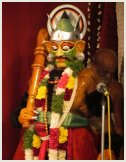
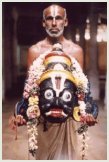
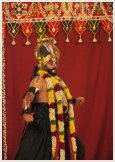
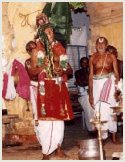
Home | Project Kaushal | Arayer Sevai About Kaisiki Natakam | Artistic Team | Tamil poem - The story of Nambaduvan | Press | Photo Gallery Kaisiki Natakam - A report on a revival project by Anita Ratnam (courtesy SRUTI, Issue 190, July 2000) Kaisiki Natakam, a heart warming and intensely human tale, has gripped the imagination of commoners and kings down the centuries. After a long hiatus, it was revived with a performance on 19th November 1999. In the Varaha Puranam, Lord Vishnu tells the story to Mahalakshmi about how he adores being worshipped through dance and music. Kaisiki Natakam, which is traced back to the 13th Century, tells the story of a lowborn “Chandala” called Nambaaduvan who devotes one night every year, on Kaisiki Ekadasi, to singing the praises of Nambi Perumal. On that day one year, he was travelling to the temple when a Rakshasa (demon) stops him and demands his flesh. After great persuasion, Nambaaduvan tells the Rakshasa that he would return to be eaten by him after completing his annual offering of music to Nambi Perumal. Convinced of the Chandala's sincerity, the Rakshasa allows him to proceed to the temple. After singing all night in front of the Lord, Nambaaduvan is in his way to the Rakshasa to fulfill his promise. At that time, Lord Vishnu himself, in the guise of an old man, stops him and asks him to take another route, warning him of a dangerous Rakshasa who eats all in his path. Nambaaduvan refuses to break his promise and proceeds to meet his death. When the Rakshasa meets him again, his mood has changed. He now demands that Nambaaduvan give over to him not his physical body but the Punyam (Fruits of good deeds) he has acquired from his musical offerings to Nambi Perumal. Nambaaduvan refuses and then is told that the Rakshasa is really a Brahmin who has attracted a curse because of his arrogance and who would be redeemed from the curse by a chandala. The story has an unusual element in that it points to the special place music and dance has in religious worship in temple societies of ancient times. The divisions of caste and class were blurred when it came to the purity of a devotee's intent. Similar to the practice connected with Vaikunta Ekadasi, devotees would fast and stay awake during the night of the Kaiski Ekadasi and listen to music and dance in praise of Nambi Perumal (the name given to Lord Vishnu in Thirukurungudi in Tirunelveli district of Tamil Nadu). This was an act of great piety. Early in 1996, Na. Muthuswami, well known Tamil theatre activist and Director of Koothu-p-Pattarai, came to see me with Prof. S Ramanujam of Tanjavur, respected theatre director and consultant. The two of them informed me about this one valuable ritual tradition which had completely declined at the temple in Tirukurungudi which is my native place. Kaisiki Natakam was performed in Tirukurungudi with great fanfare upto 1955. Due to scholars, as well as patrons like the late T.V. Sundaram Iyengar, thousands of devotees used to throng the massive temple in Tirukurungudi on the night of Kaisiki Ekadasi every year. After the demise of Sundaram Iyengar in 1955, the play, which used to extend for five hours past midnight, seemed to have lost its appeal, content and audience. I witnessed a performance for the first time in 1996. It was very poorly attended and, worse, poorly performed. All the performers were weak, aged, and had completely forgotten their roles. It is then that I decided to take up a project to revive and revitalize the Kaisiki Natakam tradition. When the project was first begun in June 1996, the tradition was almost extinct. Five artists whose family had performed this ritual play annually at Tirukurungudi were old, feeble and had forgotten almost all the words and movements. More over the script for the play was not available. In the event, it had to be traced from various sources. The first part was received from Tirunarayanan, Manager of the temple. The other part was traced to Narayanan Kambar, the artist who had performed the role of the nattuvanar who lived now in Nanguneri, a neighbouring village. A palm leaf manuscript of the natakam was subsequently found at the Jeeyar's mutt in Tirukurungudi itself. After tracing the entire text, we began the reconstruction of the music. This step by step process required the composition of few songs and some verses in Carnatic ragas, based on the rules of ancient Tamil songs. Well known vaishanavite scholar Dr. Venkatakrisnan's audio cassettes rendition of the Kaisiki Natakam was used as a reference guide during the long dialogues between the Brahma Rakshasa and the devotee Nambaaduvan. But all this was not enough. Since there were very few traces of the script, music, movement, and style, we had to undertake a complete re-creation of the play. Prof. Ramanujam had extensive discussions with musicologist in Chennai, natyacharya Herambanathan of Tanjavur and musician of the Mellatur Baghavatha Mela. Out of these discussion emerged a framework. Herambanathan identified some musicians and dancers from Thanjavur who, in the event became the first core group to learn the music and movement of the re-constructed Kaisiki Natakam. All the performers were given a background briefing and an orientation course on Kaisiki Natakam. Vinod, a college student who performs in the Bhagavata mela Natakams was asked to do the role of the Brahma Rakshasa. All the new artists who are based in Tanjavur were taken to Tirukurungudi to meet the traditional performers of Kaisiki Natakam at the Nambi temple. This visit made a great impact on both the groups. Many new discoveries about the dance, music and dialogue were made during casual conversations with the traditional artists and the local residents. Later, we also included Dorai Amma, a very well known Devadasi of Tanjavur and one of the original performers in the Sarabendra Bhoopala Kuravanji, in the revival project. A prototype of the reconstructed Kaisiki Natakam was revealed to a group of writers, theatre directors, musicians and dramateurs from Chennai, Tanjavur and Madurai on 15th September 1999 at the Venkatesa Perumal Sannidhi in Tanjavur. It was accepted by everyone and it was agreed that the artists would work towards a full-length performance in Tirukurungudi on Kaisiki Ekadasi on 19 November 1999. On Kaisiki Ekadasi day a very large crowd gathered at the Tirukurungudi temple. Before the commencement of the Kaisiki Natakam, I performed a special dance programme called Natya Aradhana. The dance, the text of which consisted of ten paasurams hymns about Tirukurungudi selected from the Divyaprabandam, was dedicated to Nambi Perumal. Hundreds of school children from the neighbouring towns attended the performance between 8 and 9 pm. Kaisiki Natakam began at 9.30 pm, after this dance, with 22 actors and musicians from Thanjavur sharing the stage with five traditional Tirukurungudi performers. All five of the traditional Tirukurungudi performers performed although one of them came to the stage briefly due to weakness and old age. She was 84 year old Ramanuji Ammal who used to take the role of Nambi Perumal disguised as the old man. Her artistic colleague also belonging to the Isai Velalar community Kurungudi Amma aged 77, was a once celebrated performer who had even danced as temple idols where taken around in processions. Even today some residents of Tirukurungudi recall her dazzling prowess in dance and music. The large crowd of 3000 persons witnessed a historic re-enactment of Kaisiki Natakam, which lasted for 3 hours and 15 minutes. Virtually all were moved to tears by the excellent performance of all the artists - and especially those of Vinod as Rakshasa and Muthulakshmi as Nambaaduvan. While the first phase of the project to re-construct and revive the Kaisiki Natakam was thus successfully completed its revitalization is still in progress. For this purpose, video and photo documentation of the performance has been done. A microfilm version is being prepared by the Saraswathi Mahal Library in Thanjavur. Work is now underway to strengthen the music and movement portions of the performance. Specialists in each area are being enlisted to work with the artists and the musicians to reconstruct the entire five hour ritual drama. For this year's celebrations, one eminent dancer will participate with the dance offering (Natya Aradhana) inside the temple precincts after which the Kaisiki Natakam will commence at about 9.30 pm and extend until 2 am in the next morning.  The Reconstruction Process: Important Details Some important details about the reconstruction and revival of the Kaisiki Natakam: The traditional raga or pann called Kaisika or Kausika is the predominant raga in this ritual play. According to musicologists like Vaithialingam, many other raga-s like Malahari, Gandharam, Nata, Dhanyasi and Vasanta, were also utilised in the play. The original palm-leaf script of the Kaisiki Natakam was written by Veerabhadra Nattuvanar in the 13th century. There are 40 paasuram-s on the Tirukurugudi Nambi perumal in the Divya Prabandham. Tirukurungudi was at one time under the control of the Travancore royal family. After the formation of the Madras Presidency, the court's hold over the temple weakened but Namboodri priests continued to conduct worship at the temple. The research and reconstruction efforts are concentrated in Tanjavur at the Bhavupillai Natya school whose director Herambanathan is a traditional natyacharya. His mother-in-law, Doraikannu, alias Revathy, is also an integral part of the process. She is making an invaluable contribution with her experience and cultural memory of the ritual dance in temples. Traditional dancers are too old, weak and unable to remember anything substantial on which to base the reconstruction. In the circumstances, only Bharatanatyam and Bhagavata Mela traditions have been used as starting points of movement and abhinaya explorations. The purpose is not to superimpose one or both styles on Kaisiki Natakam but use them as springboards for free expression. After seeing the first revival performance of the Kaisiki Natakam on 19th November 1999, elderly residents of the Tirukurungudi have made valuable inputs. Several women have come forward and offered their earlier memories of how the actors would move or speak, their tone and their mannerisms. All the suggestions have been recorded and noted for implementation in Phase II of the project.  |